The Knowledge Is at the Edges

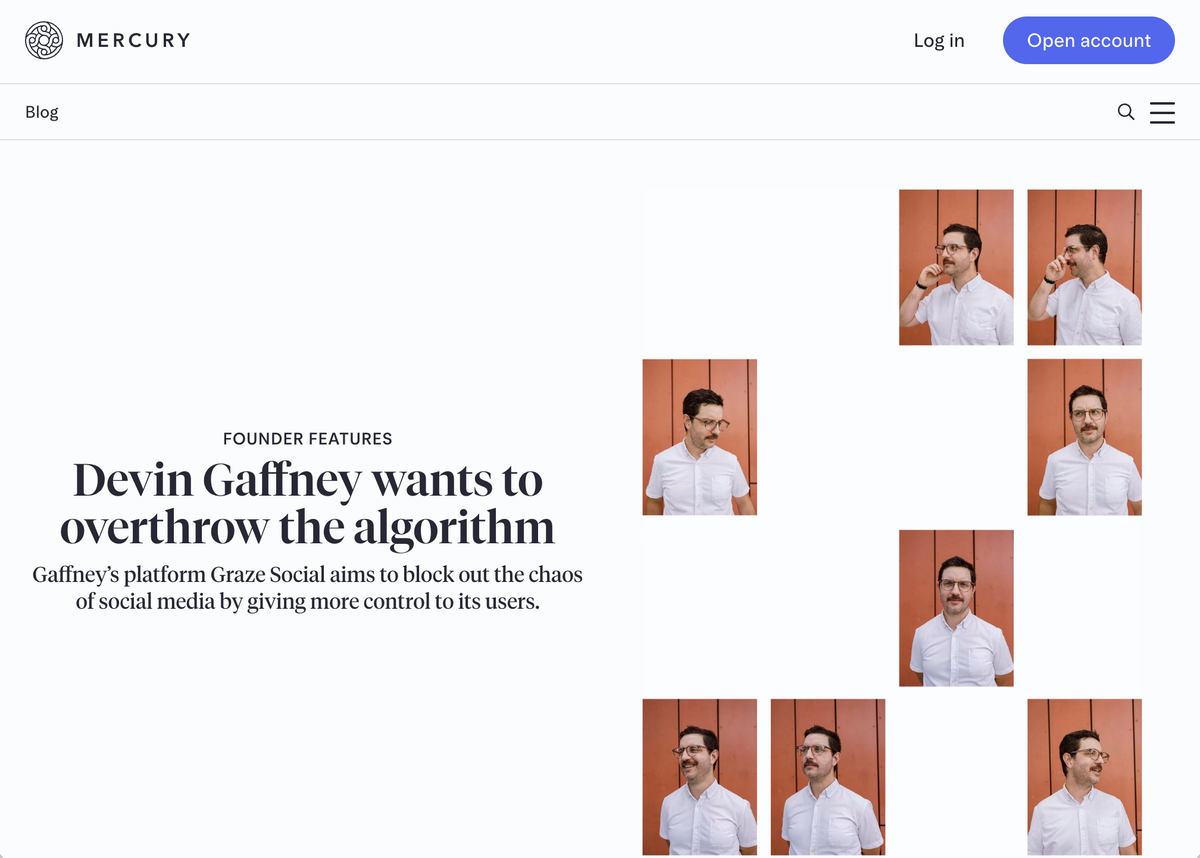
Mercury ran a profile of me last week, written by Brooke Jackson-Glidden, which is generous and gets the thing I care about right. The part worth extending is the mechanism. Every Graze feed gets built by somebody who knows more about its subject than a central ranking system ever will.
An MLS feed maintained by somebody who actually watches MLS encodes a whole set of judgments - which beat writers are worth reading, which transfer rumors are noise, which accounts reliably waste your afternoon - and engagement data can't reconstruct those judgments at any volume. The same holds for the journalism feed vetted by a working journalist, the K-pop feeds, the transit feeds, the woodworking feeds. Each one is a small quantity of expertise applied very close to its subject, doing work that a single ranking function in a single building has no mechanism to do.
The diagnosis follows from there. One ranker serving three billion people operates orders of magnitude below the bandwidth of the thing it's sorting, and additional parameters do nothing for a problem that's fundamentally about where the knowledge sits. We have spent a decade arguing over who deserves the chair and almost no time asking why there's only one of them. Mercury opens on Project Cybersyn, Allende's attempt to run the Chilean economy off 500 telex machines feeding a room of swivel chairs in Santiago, which is a good frame for exactly this reason. The room was the constraint.
What I'm most excited about at Flipboard is pushing this toward newsrooms, where the editorial judgment already exists and has for a century. A local paper ought to be able to run a feed that sits somewhere between a homepage and a timeline, weighted toward its own reporters but porous enough to carry the rest of the conversation, operating on its own standards and its own optimization target. Papers had that capability for most of their history. The last twenty years quietly took it away.
I don't have faith in myself, or in any single person, to keep holding the dial correctly. The design doesn't require it.